
How to Store Enzymes Properly: Preserve Activity and Extend Shelf Life
As high-efficiency biological catalysts, enzymes are indispensable in industrial production, scientific research and biomedical fields. Their catalytic activity relies on a unique three-dimensional structure, which is highly sensitive to environmental factors. Improper storage easily causes enzyme denaturation, activity loss and even failure, affecting product quality and experimental results. Based on professional research and industry experience, this article summarizes key points and practical methods for proper enzyme storage to help you maximize enzyme value.
1. Understand the Core Factors Affecting Enzyme Stability
To master storage methods, it is first critical to understand factors damaging enzyme activity. Enzymes are essentially proteins (or nucleic acids), with stability mainly affected by temperature, pH value, moisture and external pollutants. Deviations from the optimal range disrupt the chemical bonds maintaining the enzyme’s structure, leading to irreversible denaturation. Thus, proper storage focuses on creating a stable environment to minimize these impacts.
2. Key Storage Guidelines: Temperature Control Is the Foundation
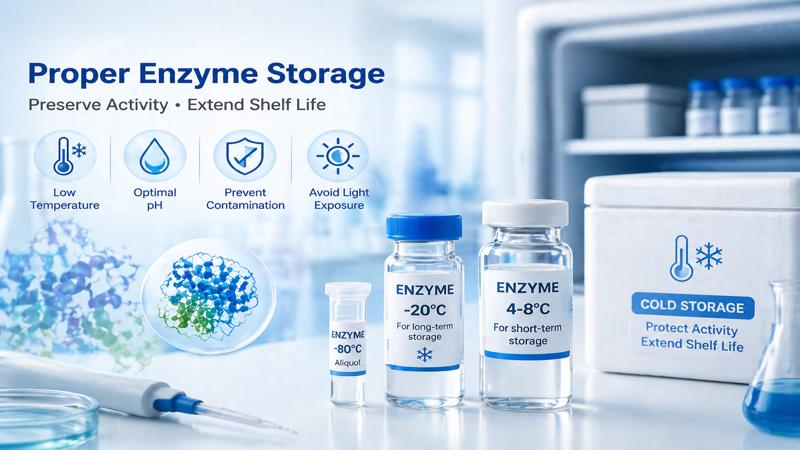
Temperature is the most critical factor for enzyme activity: low temperatures slow molecular movement and degradation, while high temperatures (usually above 60℃) break chemical bonds and cause rapid denaturation. Temperature control varies by storage cycle:
- Short-term storage (a few days to 2 weeks): Most enzymes can be stored at 4-8℃, which inhibits activity and microbial growth without damaging the enzyme structure, suitable for daily frequent use.
- Long-term storage (months to years): -20℃ or -80℃ ultra-low temperature freezers are recommended. Add 20%-50% glycerol or other cryoprotectants to prevent ice crystal formation and protein aggregation. Note that some enzymes are unsuitable for -80℃ storage.
- Avoid temperature fluctuations: Repeated freeze-thaw damages the enzyme structure. Aliquot enzymes into small volumes before freezing to minimize freeze-thaw cycles.
3. Maintain Optimal pH Value: Choose the Right Buffer
pH affects the enzyme’s surface charge and active center conformation, directly influencing substrate binding. Deviations from the optimal pH reduce catalytic efficiency, while extreme pH causes irreversible denaturation. Key points for pH control:
- Choose a buffer matching the enzyme’s optimal pH: glycine-hydrochloric acid (pH 1.5-2.0) for acidic enzymes, phosphate (pH 6.8-7.4) for neutral ones, and carbonate (pH 8.0-9.0) for alkaline ones.
- Control buffer ion strength at 50-150mM (NaCl/KCl); 200-500mM for salt-tolerant enzymes. Avoid pure water or high-concentration salt solutions for reconstitution.
- Avoid direct adjustment with strong acids/alkalis; use gradient dilution to prevent local extreme pH damage.
4. Different Enzyme Forms: Targeted Storage Methods
Enzymes are commonly liquid, lyophilized powder or tablets, with targeted storage methods based on physical properties:
- Liquid enzymes: Shortest shelf life; store in a refrigerator/ultra-low temperature freezer, keep sealed, and avoid vigorous shaking.
- Lyophilized powder enzymes: Relatively stable; store at 4℃ (short-term) or -20℃ (long-term). Avoid opening in humid environments or before reaching room temperature; add protective excipients during lyophilization.
- Tablet enzymes: Store in a cool, dry place at room temperature (≤3 months); refrigerate for long-term storage. Keep away from moisture and direct sunlight.
5. Additional Protective Measures: Avoid Contamination and Oxidation
In addition to temperature and pH control, the following measures extend enzyme shelf life:
- Prevent contamination: Use sterile containers/tools; add 0.02% sodium azide or penicillin-streptomycin if needed (note sodium azide is toxic for cell experiments).
- Avoid oxidation: Store in airtight containers; add DTT/EDTA stabilizers for oxidation-sensitive enzymes.
- Protect from light: Store in opaque containers or dark environments to avoid UV-induced activity loss.
- Add cofactors if needed: Add specific metal ions (e.g., Mg²⁺ for kinases) to the storage buffer as required.
6. Common Mistakes to Avoid
Improper operations accelerate enzyme inactivation; avoid these common mistakes:
- Long-term room-temperature storage, especially in high-temperature and high-humidity environments;
- Repeated freeze-thaw without aliquoting;
- Reconstitution with impure buffers or pure water;
- Opening lyophilized vials in humid environments or before reaching room temperature;
- Mixing enzymes with other chemicals.
Conclusion
Proper enzyme storage is key to maintaining catalytic activity and extending shelf life, with the core principle of stabilizing the enzyme’s three-dimensional structure through environmental control and targeted measures. Adhering to these guidelines reduces costs from inactivation and ensures stable experimental/production results. For more questions, contact WitrustBio professional technical team for personalized guidance.
© Copyright - | All Right Reserved. Designed By witrustbio.com
 Send Email
 Philip Wu
 Frank68001